Unlike traditional drilling and blasting methods, TBMs provide a more controlled, efficient, and safer approach to underground construction. Their ability to operate continuously with minimal disruption makes them essential in modern urban development and transportation projects.
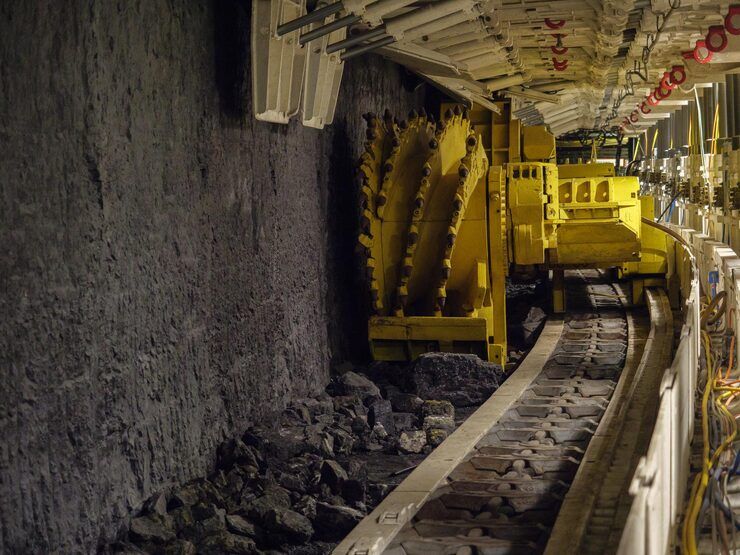
How Tunnel Boring Machines Work
A tunnel boring machine operates by rotating a cutting head equipped with disc cutters or tools that break down rock and soil. The excavated material is then transported away through a conveyor or slurry system.
The process generally follows these steps:
- The rotating cutter head excavates the ground
- Excavated material is collected and transported out
- Tunnel lining segments are installed behind the machine
- Hydraulic systems push the machine forward
- Continuous monitoring ensures alignment and safety
This automated cycle allows TBMs to maintain precision and consistency throughout the tunneling process.
Structure and Key Components
TBMs are complex machines made up of multiple integrated systems that work together efficiently.
Core Components
- Cutter Head: Rotating front section that breaks soil or rock
- Shield: Protective structure that supports tunnel walls
- Thrust System: Hydraulic jacks that move the machine forward
- Muck Removal System: Conveyor belts or slurry pipelines
- Segment Erector: Installs precast concrete lining segments
- Control System: Digital monitoring and navigation tools
Each component plays a crucial role in ensuring safe and accurate tunneling operations.
Types of Tunnel Boring Machines
Different ground conditions require different TBM designs. Selecting the right type is essential for project success.
Common TBM Types
-
Earth Pressure Balance (EPB) TBM
Suitable for soft soil conditions, maintaining pressure balance at the tunnel face -
Slurry TBM
Uses pressurized slurry to stabilize loose or water-bearing ground -
Hard Rock TBM
Designed for tunneling through solid rock formations -
Mixshield TBM
Combines slurry and EPB technologies for variable ground conditions -
Open TBM
Used in stable rock conditions without a protective shield
Importance of Tunnel Boring Machines
TBMs are essential for modern infrastructure development due to their efficiency, safety, and precision.
Key Benefits
- Reduced surface disruption in urban areas
- Improved worker safety compared to blasting
- High accuracy in tunnel alignment
- Continuous operation increases productivity
- Lower environmental impact such as reduced noise and vibration
These advantages make TBMs a preferred choice for large-scale underground construction.
Real-World Applications
Tunnel boring machines are used across various industries and infrastructure sectors.
Major Use Cases
- Metro and railway tunnels
- Road and highway tunnels
- Water supply and sewage systems
- Hydroelectric power projects
- Underground cable and utility networks
In densely populated cities, TBMs are crucial for expanding underground transport systems without affecting existing structures.
Problems Solved by TBMs
TBMs address several challenges associated with underground construction.
- Eliminate risks of uncontrolled explosions
- Reduce structural damage to nearby buildings
- Manage groundwater and unstable soil conditions
- Enable construction in confined urban spaces
- Improve project timelines through automation
These solutions help ensure safer and more predictable project outcomes.
Key Features of Modern TBMs
Modern tunnel boring machines incorporate advanced technologies to enhance performance and reliability.
Notable Features
- Real-time monitoring systems
- Automated guidance and navigation
- High-performance cutting tools
- Advanced sealing systems for water pressure
- Data-driven predictive maintenance
These innovations contribute to efficient and safe tunneling operations.
Recent Trends and Developments (2025–2026)
Tunnel boring technology continues to evolve with advancements in automation, sustainability, and digital integration.
Latest Updates
- 2025: Increased use of AI-based monitoring systems for predictive maintenance and risk detection
- 2025: Adoption of electric and hybrid TBMs to reduce carbon emissions
- 2026: Integration of digital twin technology for real-time simulation and optimization
- 2026: Development of modular TBMs for faster assembly and deployment
- 2025–2026: Growing use of robotics for segment installation and inspection
These developments are improving efficiency, reducing environmental impact, and enhancing safety.
Regulations and Safety Standards
Tunnel construction using TBMs is governed by strict engineering and safety regulations to ensure worker safety and structural integrity.
Key Standards and Guidelines
- Occupational safety regulations for underground work
- Environmental impact assessment requirements
- Structural design standards for tunnel lining
- Groundwater management policies
- Machinery safety and maintenance protocols
Compliance with these regulations is essential for successful project execution and long-term durability.
Useful Tools and Learning Resources
Professionals and students interested in tunnel engineering can explore various tools and platforms.
Recommended Resources
- Engineering simulation software for tunnel design
- Geological analysis tools for soil and rock assessment
- Online courses in civil and geotechnical engineering
- Industry publications and technical journals
- Infrastructure project case studies
These resources help in understanding both theoretical and practical aspects of TBM technology.
Comparison of TBM Types
| TBM Type | Suitable Ground | Key Advantage | Limitation |
|---|---|---|---|
| EPB TBM | Soft soil | Pressure balance | Limited for hard rock |
| Slurry TBM | Water-bearing soil | Excellent stability | Complex system |
| Hard Rock TBM | Solid rock | High cutting efficiency | Not suitable for soft soil |
| Mixshield TBM | Mixed conditions | Versatile operation | Higher complexity |
| Open TBM | Stable rock | Simple design | No ground support |
FAQs
What is a tunnel boring machine used for?
A tunnel boring machine is used to excavate tunnels for transportation, utilities, and infrastructure projects while maintaining structural stability and safety.
How fast can a TBM dig a tunnel?
The speed depends on ground conditions and machine type, but TBMs can typically advance several meters per day under optimal conditions.
Are tunnel boring machines safe?
Yes, TBMs are considered safer than traditional methods due to controlled excavation, reduced vibration, and advanced monitoring systems.
What is the lifespan of a TBM?
A TBM can last for multiple projects if properly maintained, though cutting tools and components may need replacement during operation.
What factors determine the type of TBM used?
Ground conditions, tunnel diameter, water presence, and project requirements are the main factors influencing TBM selection.
Conclusion
Tunnel boring machines play a vital role in modern infrastructure development by enabling efficient, precise, and safe underground construction. Their advanced engineering, adaptability to different geological conditions, and continuous technological improvements make them indispensable in urban planning and large-scale projects.
As innovations such as automation, digital monitoring, and sustainable design continue to evolve, TBMs are set to become even more efficient and environmentally responsible, shaping the future of underground engineering.