The main purpose of an electric motor is to provide controlled motion and mechanical power. From powering conveyor belts in manufacturing plants to running compressors, pumps, and fans, electric motors are essential to modern infrastructure and high-efficiency systems.
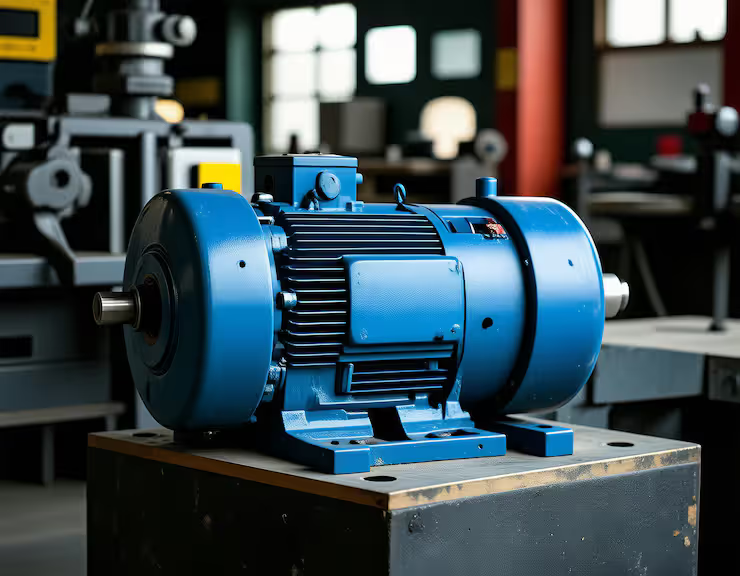
How an Electric Motor Works
Electric motors function through the interaction between magnetic fields and electric currents. When electricity flows through a conductor placed in a magnetic field, it produces a force that causes movement.
In most motors:
- An electric current flows through coils (windings)
- These coils create a magnetic field
- The interaction between this magnetic field and a fixed magnetic field generates rotational motion
This motion is transferred to a shaft, which powers mechanical systems such as pumps, fans, or industrial equipment.
Core Components of an Electric Motor
Key Parts
- Stator: The stationary part that produces a magnetic field
- Rotor: The rotating part that turns due to electromagnetic force
- Windings: Coils of wire that carry current
- Commutator (in DC motors): Reverses current direction
- Bearings: Support rotation and reduce friction
- Shaft: Transfers mechanical output
Types of Electric Motors
Electric motors are categorized based on their power source and operating principles.
Major Types
-
AC Motors
- Induction Motor
- Synchronous Motor
-
DC Motors
- Brushed DC Motor
- Brushless DC Motor (BLDC)
-
Special Motors
- Stepper Motor
- Servo Motor
- Linear Motor
Electric Motor Comparison Table
| Motor Type | Power Source | Efficiency | Maintenance | Common Applications |
|---|---|---|---|---|
| Induction Motor | AC | High | Low | Industrial machinery, pumps |
| Synchronous Motor | AC | Very High | Moderate | Precision systems, robotics |
| Brushed DC Motor | DC | Medium | High | Small tools, appliances |
| BLDC Motor | DC | Very High | Low | EVs, drones, automation |
| Stepper Motor | DC | Moderate | Low | CNC machines, 3D printers |
| Servo Motor | AC/DC | High | Moderate | Robotics, control systems |
Importance of Electric Motors
Electric motors are foundational to energy-efficient systems and industrial automation. Their importance includes:
- Enabling mechanical automation in manufacturing
- Supporting renewable energy systems
- Reducing dependency on fossil-fuel-powered engines
- Enhancing energy efficiency in appliances and machines
- Providing precise motion control in robotics and AI-driven systems
Electric motors are also central to electrification trends, particularly in transportation and smart infrastructure.
Real-World Applications
Electric motors are used across multiple sectors:
Industrial Use Cases
- Conveyor systems in factories
- HVAC systems and compressors
- CNC machines and vertical machining centers
- Pumps and water treatment systems
Consumer Applications
- Washing machines and refrigerators
- Electric fans and air conditioners
- Power tools
Advanced Applications
- Electric vehicles (EVs)
- Robotics and automation
- Aerospace systems
- Renewable energy systems (wind turbines)
Key Features of Modern Electric Motors
Performance Characteristics
- High energy efficiency
- Low noise operation
- Compact design
- High torque-to-weight ratio
- Long operational life
Smart Capabilities
- IoT-enabled monitoring
- Predictive maintenance integration
- Variable speed control using drives
- Real-time performance analytics
Recent Trends and Developments (2025–2026)
Electric motor technology continues to evolve rapidly with a focus on efficiency, sustainability, and intelligent systems.
- 2025: Increased adoption of high-efficiency IE4 and IE5 motors in industrial automation
- 2025: Expansion of electric vehicle production driving demand for BLDC and synchronous motors
- 2026: Integration of AI-based predictive maintenance systems in smart factories
- 2026: Development of rare-earth-free motors to reduce material dependency
- Growth in compact, high-power-density motors for robotics and drones
Regulations and Standards
Electric motors are subject to efficiency and safety regulations worldwide.
Key Standards
- IEC Efficiency Classes (IE1 to IE5)
- NEMA Standards (North America)
- Energy Efficiency Regulations (EU Ecodesign Directive)
- Bureau of Energy Efficiency (BEE - India)
These standards ensure
- Reduced energy consumption
- Environmental sustainability
- Safe and reliable operation
Tools and Learning Resources
Useful Tools
- Motor selection software (e.g., design calculators)
- Simulation tools for electromagnetic analysis
- Industrial IoT platforms for monitoring
Learning Resources
- Engineering textbooks on electrical machines
- Online courses in electrical engineering and automation
- Technical documentation from manufacturers
- Industry webinars and certification programs
Common Challenges and Solutions
Electric motors, while efficient, face certain operational challenges.
Challenges
- Overheating due to overload
- Energy losses from inefficiency
- Wear and tear of components
- Voltage fluctuations
Solutions
- Use of variable frequency drives (VFDs)
- Regular maintenance and lubrication
- Smart monitoring systems
- Proper motor sizing and installation
FAQs
What is the main function of an electric motor?
An electric motor converts electrical energy into mechanical energy to perform work such as rotation or movement.
Which motor is most efficient?
Brushless DC motors and synchronous motors are among the most efficient due to reduced energy loss and advanced control systems.
Where are electric motors commonly used?
They are used in industries, household appliances, electric vehicles, robotics, and HVAC systems.
What is the difference between AC and DC motors?
AC motors run on alternating current and are widely used in industrial settings, while DC motors run on direct current and are common in portable devices and EVs.
How can motor efficiency be improved?
Efficiency can be improved using high-grade materials, proper maintenance, smart controllers, and energy-efficient motor designs.
Conclusion
Electric motors are a cornerstone of modern technology, enabling efficient energy conversion across countless applications. Their role in industrial automation, transportation, and smart systems continues to grow as technology advances. With improvements in efficiency, intelligent monitoring, and sustainable design, electric motors are becoming more powerful, reliable, and environmentally friendly.
Understanding their working principles, types, and applications helps industries and individuals make informed decisions about energy use and system design. As global demand for electrification increases, electric motors will remain central to innovation and progress.