The primary purpose of a jet mill machine is to achieve micron and sub-micron particle sizes with high precision. These machines are widely used in industries such as pharmaceuticals, chemicals, minerals, and food processing where fine particle control is essential for performance, quality, and safety.
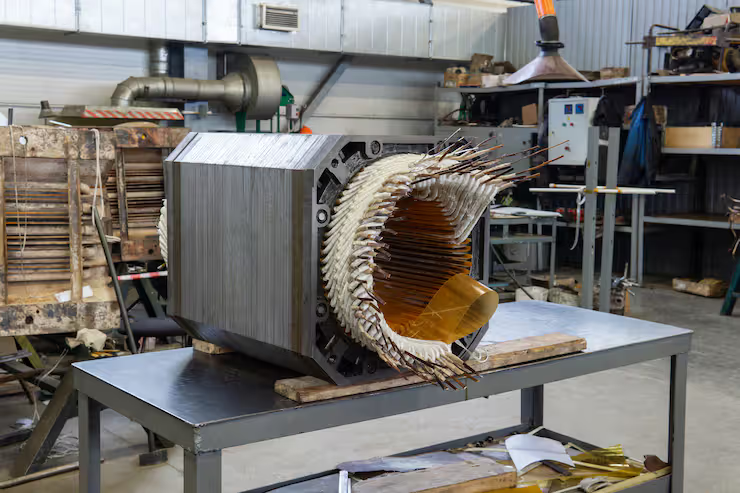
Unlike traditional milling systems, jet mills eliminate contamination risks because they do not rely on metal grinding parts. This makes them ideal for applications requiring high purity and consistent particle distribution.
Working Principle and Structure
Jet mill machines use compressed air or inert gas to create high-speed jets inside a grinding chamber. Particles are fed into the chamber and accelerated by these jets, resulting in high-energy collisions between particles.
The process involves:
- Particle acceleration through nozzles
- pr Particle-to-particle impact for size reduction
- Centrifugal classification for size control
- Fine particles exiting while coarse particles recirculate
This mechanism ensures uniform particle size distribution and avoids excessive heat generation, making it suitable for heat-sensitive materials.
Importance in Modern Industries
Jet mill machines play a critical role in industries that demand precision and purity. Their ability to produce ultra-fine powders with minimal contamination supports advanced manufacturing processes.
Key importance includes:
- High precision particle size control
- Contamination grinding environment
- Suitable for heat-sensitive materials
- Enhanced product quality and consistency
- Support for high-performance material applications
Industries such as pharmaceuticals rely on jet mills for drug formulation, where particle size directly impacts bioavailability and effectiveness.
Real-World Use Cases
Jet mill machines are used across multiple sectors where fine particle processing is essential.
Industrial Applications
- Pharmaceutical manufacturing for active ingredients
- Chemical processing for pigments and coatings
- Food industry for spices, sugar, and additives
- Mineral processing for fine powders
- Cosmetics for smooth and uniform textures
These machines help solve challenges related to particle uniformity, contamination control, and energy-efficient grinding.
Key Features and Components
Jet mill machines are designed with precision engineering to deliver consistent results.
Core Features
- No moving grinding parts
- High-speed air or gas jets
- Integrated particle classification system
- Low heat generation
- Adjustable particle size output
Main Components
- Grinding chamber
- Air compressor or gas supply system
- Nozzles for particle acceleration
- Classifier for size separation
- Cyclone separator or dust collector
These components work together to ensure efficient and controlled particle reduction.
Types of Jet Mill Machines
Different types of jet mills are available depending on application needs and material characteristics.
Common Types
- Fluidized bed jet mill
- Spiral jet mill
- Opposed jet mill
- Loop jet mill
Each type offers specific advantages in terms of particle size control, throughput, and energy efficiency.
Comparison Table of Jet Mill Types
| Type of Jet Mill | Working Mechanism | Best Use Case | Particle Size Range |
|---|---|---|---|
| Fluidized Bed Jet Mill | Air jets with classifier system | Pharmaceuticals, fine chemicals | 1–10 microns |
| Spiral Jet Mill | Circular airflow grinding | Food and cosmetics | 2–20 microns |
| Opposed Jet Mill | Opposing jets for collision | Minerals and hard materials | 1–5 microns |
| Loop Jet Mill | Closed-loop gas circulation | High-purity applications | Sub-micron |
Recent Trends and Developments (2025–2026)
Jet milling technology has evolved significantly in recent years, focusing on efficiency, automation, and sustainability.
Key developments include:
- Integration of AI-based process control systems (2025)
- Energy-efficient compressed air systems reducing power consumption (2025)
- Advanced classifier designs for ultra-fine particle control (2026)
- Increased use of inert gas systems for reactive materials (2026)
- Adoption of Industry 4.0 monitoring tools for real-time performance tracking
These advancements improve productivity, reduce operational waste, and enhance process reliability.
Regulations and Industry Standards
Jet mill machines are subject to various industrial and safety regulations depending on their application.
Key regulatory considerations:
- Good Manufacturing Practices (GMP) for pharmaceutical use
- ISO standards for equipment quality and safety
- Environmental regulations for dust and emissions control
- Occupational safety guidelines for compressed air systems
Compliance with these regulations ensures safe operation and consistent product quality.
Useful Tools and Learning Resources
Professionals working with jet mill machines often rely on technical tools and platforms for optimization and learning.
Recommended Resources
- Engineering simulation software for airflow modeling
- Process monitoring systems for particle size analysis
- Industry publications on powder technology
- Online courses in material science and industrial processing
- Technical manuals from equipment manufacturers
These resources help improve operational efficiency and deepen understanding of milling technologies.
Advantages and Limitations
Advantages
- High purity and contamination processing
- Precise particle size control
- Suitable for heat-sensitive materials
- Minimal mechanical wear
Limitations
- High energy consumption due to compressed air
- Limited efficiency for large particle sizes
- Requires specialized setup and maintenance
Understanding these factors helps industries select the right milling solution for their needs.
Frequently Asked Questions
What is a jet mill machine used for?
Jet mill machines are used for ultra-fine grinding of materials in industries such as pharmaceuticals, chemicals, and food processing, where precise particle size is critical.
How does a jet mill differ from traditional mills?
Unlike traditional mills, jet mills use high-speed air or gas streams instead of mechanical grinding parts, reducing contamination and heat generation.
What materials can be processed in a jet mill?
Jet mills can process a wide range of materials including powders, chemicals, minerals, and heat-sensitive substances.
Why is particle size important in jet milling?
Particle size affects product quality, performance, and application efficiency, especially in pharmaceuticals and advanced materials.
Are jet mill machines energy efficient?
Modern jet mills are becoming more energy-efficient with improved air systems, but they still require significant energy compared to some mechanical mills.
Conclusion
Jet mill machines are essential tools in modern industrial processing, offering precise and contamination particle size reduction. Their unique working principle, based on high-velocity air streams, makes them ideal for applications requiring ultra-fine powders and high purity.
With advancements in automation, energy efficiency, and process control, jet milling technology continues to evolve, supporting industries in achieving better performance and sustainability. Understanding their structure, types, and applications helps organizations make informed decisions and optimize their production processes.