The primary purpose of an industrial knitting machine is to improve production efficiency, reduce human error, and enable large-scale manufacturing with precise control over fabric patterns, density, and elasticity.
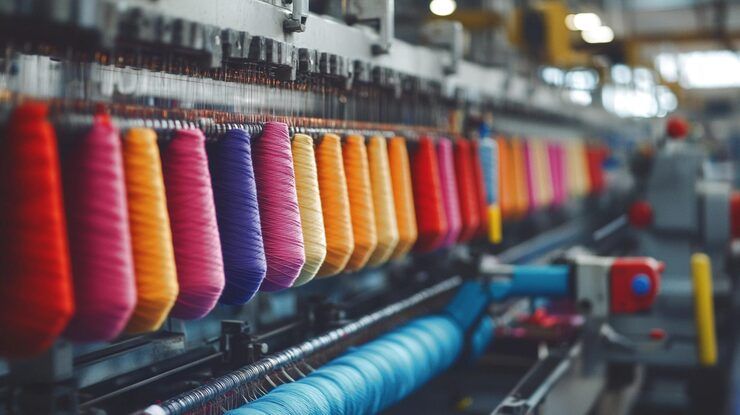
How Industrial Knitting Machines Work
Industrial knitting machines operate by interlocking yarn loops using a series of needles arranged in a specific configuration. These needles move in a synchronized pattern to create continuous rows of loops known as courses and wales.
The process typically involves:
- Feeding yarn through tension-controlled systems
- Needles forming loops by pulling yarn through previous loops
- Carriage or cylinder movement controlling pattern formation
- Automated systems managing speed, tension, and stitch accuracy
Modern machines often integrate computerized controls that allow operators to program complex patterns and adjust settings digitally.
Types of Industrial Knitting Machines
Industrial knitting machines are categorized based on their structure and fabric output.
Weft Knitting Machines
- Produce fabric by forming loops horizontally
- Common for T-shirts, socks, and sweaters
- Includes circular and flat knitting machines
Warp Knitting Machines
- Create fabric by forming loops vertically
- Used for technical textiles and lace
- Known for higher stability and strength
Circular Knitting Machines
- Use a rotating cylinder
- Produce seamless tubular fabrics
- Ideal for mass production
Flat Knitting Machines
- Use a flat needle bed
- Suitable for shaped garments
- Allows detailed pattern control
Computerized Knitting Machines
- Controlled by software
- Enable automated pattern creation
- Reduce manual intervention
Key Components of Industrial Knitting Machines
Understanding the main components helps explain how these machines achieve precision and speed.
Needles
- Core elements that form loops
- Available in different types such as latch needles and spring needles
- Supply yarn consistently
- Maintain tension and prevent breakage
Cylinder or Needle Bed
- Holds needles in place
- Determines fabric structure
- Help control loop formation
- Maintain fabric stability
Control System
- Manages machine operations
- Includes digital interfaces in modern systems
Importance in Textile Manufacturing
Industrial knitting machines play a critical role in modern textile production due to their efficiency and scalability.
They help:
- Increase production speed significantly
- Ensure consistent fabric quality
- Reduce material waste
- Enable complex fabric designs
- Support mass production for global markets
Their ability to produce large volumes with minimal variation makes them essential for industries relying on uniform textile output.
Real-World Applications
Industrial knitting machines are widely used across different sectors.
Apparel Industry
- Production of garments such as T-shirts, sweaters, and sportswear
- Seamless knitting for comfort and flexibility
- Seat covers and interior fabrics
- Durable and stretchable materials
Medical Textiles
- Compression garments
- Bandages and orthopedic supports
- Geotextiles for construction
- Industrial fabrics for filtration and insulation
Problems Solved by Industrial Knitting Machines
These machines address several challenges in textile manufacturing.
- Labor-intensive manual knitting processes
- Inconsistent product quality
- Limited scalability
- High production time
- Difficulty in creating complex patterns
By automating production, they ensure efficiency, precision, and repeatability.
Key Features of Modern Industrial Knitting Machines
Automation Capabilities
- Computer-controlled operations
- Minimal manual intervention
- Capable of producing large volumes quickly
Pattern Customization
- Digital pattern programming
- Flexibility in design
- Optimized motor systems
- Reduced energy consumption
Precision Control
- Accurate stitch formation
- Consistent fabric quality
Industrial Knitting Machine Comparison Table
| Feature | Weft Knitting Machine | Warp Knitting Machine | Circular Machine | Flat Machine |
|---|---|---|---|---|
| Loop Direction | Horizontal | Vertical | Circular | Flat |
| Fabric Type | Stretchable | Stable | Tubular | Shaped |
| Production Speed | Moderate | High | Very High | Moderate |
| Pattern Flexibility | High | Medium | Medium | Very High |
| Common Applications | Apparel | Technical textiles | Hosiery | Sweaters |
Recent Trends and Developments (2025–2026)
The textile machinery industry has seen significant advancements in the past year.
- AI Integration (2025): Machines now use artificial intelligence for defect detection and predictive maintenance
- Smart Knitting Systems (2025): IoT-enabled machines allow real-time monitoring and remote control
- Sustainable Manufacturing (2026): Increased focus on reducing yarn waste and energy consumption
- 3D Knitting Technology (2026): Enables seamless garment production with minimal cutting
- Advanced Software Interfaces (2025): Improved user interfaces for easier pattern design and machine control
These developments are helping manufacturers improve efficiency while aligning with environmental standards.
Regulations and Industry Standards
Industrial knitting machines must comply with various safety and quality standards.
- ISO standards for textile machinery safety
- Environmental regulations for energy consumption and emissions
- Workplace safety guidelines for machine operation
- Quality control standards for fabric production
Compliance ensures safe operation and consistent product quality across global markets.
Tools and Learning Resources
Professionals and learners can explore various tools and platforms to understand industrial knitting technology.
Software Tools
- CAD software for textile design
- Machine programming interfaces
- Simulation tools for fabric structure
Learning Resources
- Textile engineering courses
- Technical training programs
- Industry publications and research papers
- Online tutorials on knitting technology
Industry Platforms
- Textile machinery exhibitions
- Manufacturing technology forums
- Professional textile associations
Frequently Asked Questions
What is an industrial knitting machine used for?
It is used to produce knitted fabrics at high speed for industries such as apparel, medical textiles, and technical applications.
What is the difference between weft and warp knitting?
Weft knitting forms loops horizontally and is more flexible, while warp knitting forms loops vertically and produces more stable fabrics.
Are industrial knitting machines automated?
Yes, most modern machines are highly automated and controlled through computerized systems.
What industries rely on industrial knitting machines?
Industries such as fashion, automotive, healthcare, and construction use these machines for fabric production.
What skills are needed to operate these machines?
Basic knowledge of textile engineering, machine operation, and software control systems is helpful for operating industrial knitting machines.
Conclusion
Industrial knitting machines are a cornerstone of modern textile manufacturing, enabling high-speed production, consistent quality, and advanced fabric design. With continuous technological advancements such as AI integration and sustainable production methods, these machines are becoming more efficient and adaptable to evolving industry needs.
Their ability to address production challenges while supporting innovation makes them essential tools in both traditional and emerging textile sectors.